
Lottery winner counts: a blank cell is not a reported zero
A reported winner count of 0 is a value; an unexplained blank is an unresolved field. Replacing blanks with zero can make a copied lottery archive appear more complete than it is. It also changes averages without adding any verified information.
This guide in the jiliko lottery section works through five fictional draw records. The exercise concerns data interpretation, not live PCSO results, unique winning people or the probability of a future prize.
Keep the copied value and its status separately
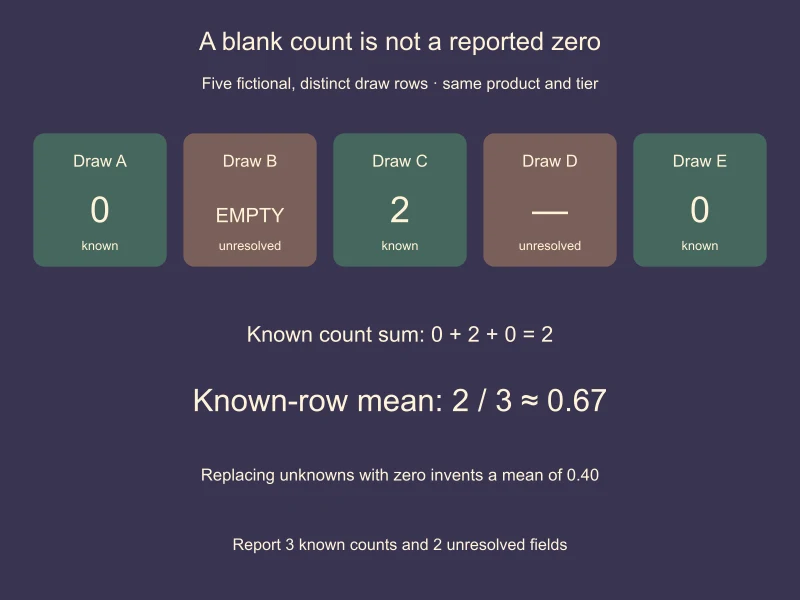
Assume the five records belong to the same fictional product, session and prize tier, and that their draw identities are distinct. Draw A explicitly reports 0, draw B has an empty winner-count cell, draw C reports 2, draw D contains an unexplained dash, and draw E explicitly reports 0.
For this exercise, only the numerical entries have been confirmed as winner counts. The blank and dash have not been explained by the source. They might reflect an incomplete copy, an unpublished field or another meaning. The example does not choose between those possibilities.
| Fictional draw | Copied field | Interpretation retained |
|---|---|---|
| A | 0 | Known numerical count: zero |
| B | Empty | Unresolved; no numerical count assigned |
| C | 2 | Known numerical count: two |
| D | — | Unresolved; dash meaning not verified |
| E | 0 | Known numerical count: zero |
Preserve the raw blank or dash alongside a status such as “unresolved.” Putting 0 into the normalized count field would assert something the record has not established. A missing entire draw row is another issue: it is not represented by any of these five rows.
Show the denominator used by an average
The three known numerical records have a count sum of 0 + 2 + 0 = 2. Their arithmetic mean is 2/3, approximately 0.67 reported winners per known draw row. State that scope explicitly: three known counts among five copied draw records.
If B and D are silently filled with zeros, the mean becomes 2/5 = 0.40. That describes an invented five-value dataset. If the two genuine zeros are dropped instead, the only retained value is 2, so the mean becomes 2.00. Neither operation answers the original known-record question.
A spreadsheet can calculate correctly from a misleading range
Microsoft’s AVERAGE documentation distinguishes numerical zero from empty cells and text in a referenced range: zeros participate in the calculation, while the latter do not. The software behaviour explains why a range with only the three numeric counts can yield 2/3. It does not verify what a lottery page’s blank or dash means.
Keep an explicit count-status column rather than relying on how cells look. A numeric zero may be hidden by display settings; a visible “0” may have been imported as text. Check the underlying value before reporting which rows contributed. A text marker such as an unexplained dash is not a confirmed numerical zero just because a formula ignores it.
These are documented spreadsheet semantics, not a claim that a particular workbook was opened or an operator’s archive was tested. The worked fractions in this article were checked independently from the five stated example records.
An unresolved field can change the conclusion later
Suppose a later verified correction for the same fictional draw B supplies a count of 1. Update B’s status to known and retain the earlier blank in the correction history. The known count sum is now 3 across four rows, so the known-row mean becomes 3/4 = 0.75. D remains unresolved.
Do not append the corrected B as a sixth draw. It is a revision of an existing draw identity. If a source confirms that a particular dash means zero for that exact field and product, record the supporting definition before changing its normalized value. Do not carry that interpretation automatically to other products or prize tiers.
Counts, people and prize money remain different quantities
An average count per known row is not the number of unique people, a payout amount or a player’s winning chance. Keep the same product and tier in scope before combining rows. A jackpot-winner column and a lower-tier winner column can count different things even if both use whole numbers.
The existing guide to reading the Winners column in a PCSO result table explains that field-level boundary. This article adds the missing-value question: whether a copied cell supplies any count to interpret in the first place.
Publish a summary with its coverage
For the original example, a reproducible summary is: “Five distinct copied draw rows; three known numerical counts; two unresolved fields; known count sum 2; mean among known rows 2/3.” It does not claim the full five-row total is known. If no numerical counts have been verified, report that no known-row mean is available rather than outputting zero.
Source and example arithmetic checked on 10 October 2026. The example helps expose incomplete data and the denominator used; it is not an actual result archive or a forecast.