
Same slot title, different edition: attach each rule to its own version
Published — UTC

A game name is a useful label, but it is not a complete identity. Two screens with the same title can describe different editions, modes or rule revisions. Combining their values can create a specification that neither screen actually supports.
Build an identity row before comparing values
Consider two invented product descriptions named “Harbour Gems.” No real supplier or product is represented.
| Field | Description A | Description B |
|---|---|---|
| Title | Harbour Gems | Harbour Gems |
| Edition label | Classic | Expanded |
| Mode | Base | Feature |
| Minimum qualifying count | 8 symbols | 10 symbols |
| Rules revision | R1 | R2 |
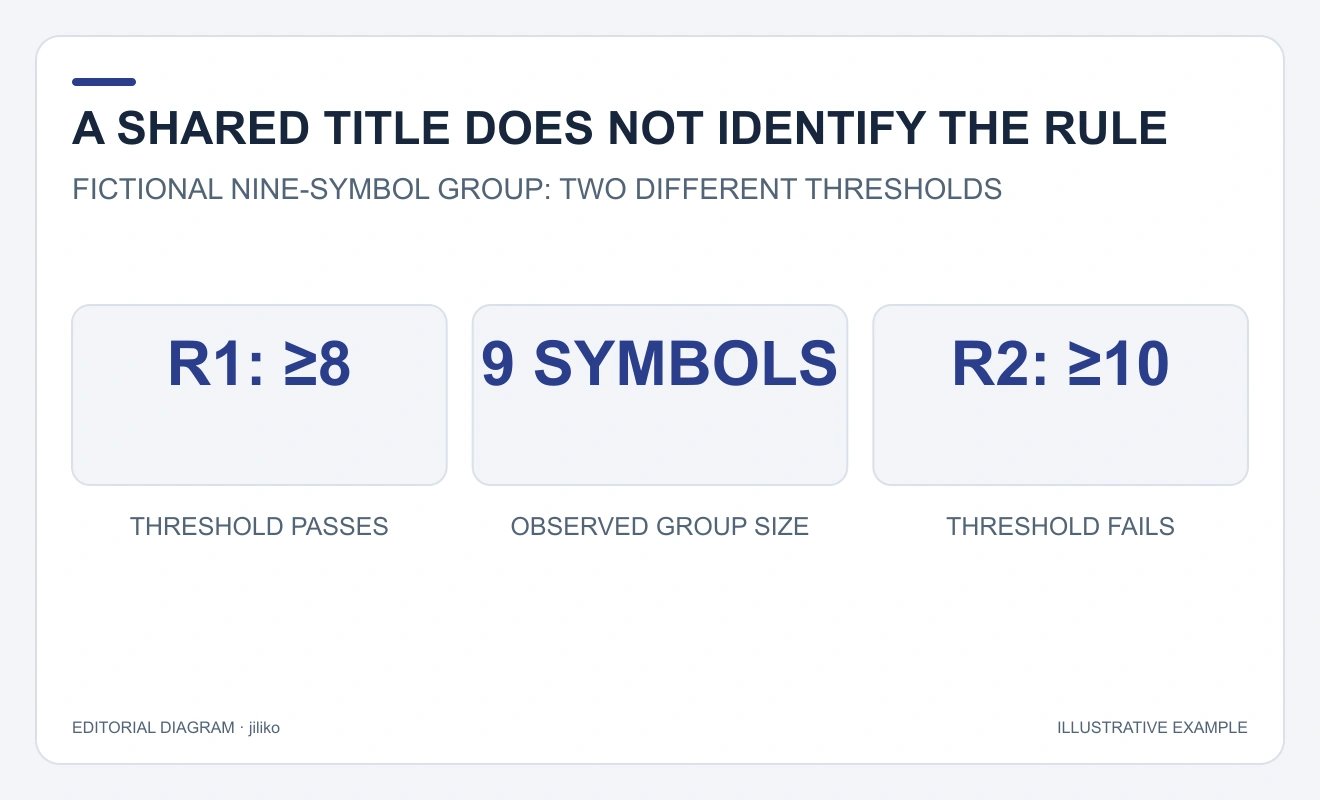
A nine-symbol group passes A’s stated threshold and fails B’s. Taking B’s artwork but A’s threshold would therefore give an unsupported answer. The shared title cannot decide which rule applies.
Keep the evidence attached to its version
- Record the provider, edition and game identifier shown by the source.
- Open the rules for the actual mode being described.
- Save the revision or retrieval date separately from the game title.
- Attach every quoted limit or threshold to that identity row.
A date when an article was updated does not itself prove a provider changed its game. If the revision is unavailable, mark it unknown. Do not invent a launch date, certified configuration or relationship with a supplier to fill the gap.
Resolve a conflict by narrowing the claim
The British rules-description reference provides context for explicit game information. It does not establish which of the invented editions exists.
Test the boundary without inventing the rest of the game
Eight qualifying symbols meet A’s minimum but not B’s; ten meet both minimums. That does not prove ten symbols receive the same award in both editions. Eligibility and the amount assigned after eligibility are separate fields, and either edition may have other conditions not present in this small example.
A compact evidence record
Keep one record per assertion: the game identifier shown, provider if stated, edition, mode, revision if available, exact rule being described, source location and retrieval time. For example: “Harbour Gems / Expanded / Feature / R2 / minimum 10 / rules panel captured at time T.” The product and panel are invented here to demonstrate the fields, not supplied as an actual citation.
A page fetched today can contain an older rules document. A newer-looking cabinet can display the same revision. Neither visual freshness nor retrieval date establishes that a rule changed.
When two sources still conflict
Preserve both statements with their identities. Check whether one is a general overview and the other an edition-specific rule, or whether a source names another mode. If those checks do not resolve the mismatch, say which threshold is unconfirmed. Do not silently merge an appealing feature from one source with a more favourable award from another.
A reader should be able to locate the same rule and understand the boundaries of the conclusion. “Nine passes the stated R1 minimum” is supported by the worksheet; “this named site will pay a nine-symbol result” requires actual accepted-game and settlement evidence that the worksheet does not provide.